The Life & Times of
W.S. Teator
Documenting the life of William Seward Teator, Upper Red Hook apple farmer, naturalist, collector, and correspondent.

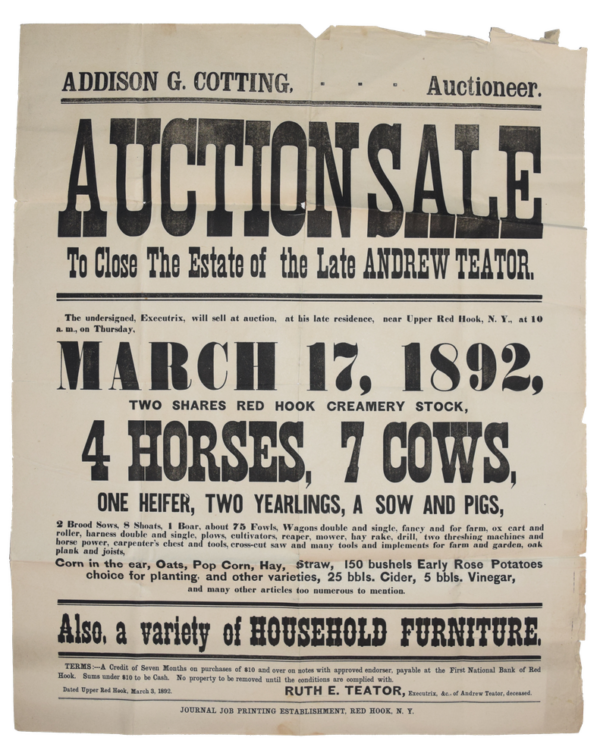
Auction poster for the estate of Andrew Teator in 1892. From the personal collection of Sarah K. Hermans.
In 1767, Henry Teator purchased 164 acres of land from Barent Van Benthuysen on Starbarrack Road in Upper Red Hook. This farm, according to his great-grandson, operated through the late eighteenth and early nineteenth centuries as a “system of general or mixed agriculture.” Henry’s grandson, Andrew Teator, inherited the farm in 1856 and is noted in a history of Dutchess County as a “farmer and fruit grower, 182 acres.” Andrew’s son, William S., described his father’s farm as the first in the succession of Teator owners to attempt “special things.”
On February 27, 1892, William S. Teator purchased the farm from his mother Ruth, “containing 192 acres, 2 roads, and 30 perches” for $4,500. William renamed it Meadow Brook Farm after his purchase but rebranded his product later in his career as Teator’s Blue Ribbon Apples. He shifted the focus of the farm primarily to apple growing, with 110 acres cultivated in orchards. During William’s time, Red Hook became “famed for its fine apples,” and due to his efforts to study the science of apple growing and advertisement of his apples as an exhibitor at “chief apple shows of the country,” the apples of northern Dutchess County were known worldwide.
“Mr. Teator always a student was as a boy an ardent naturalist, not only as a collector but going keenly after scientific knowledge of the things he was interested in. Also, having the scientific turn, he was as a farm boy an early reader of the Rural New Yorker, and this with the observation of his father’s good methods he acquired the reasons for things and a taste for the agricultural life.”
William S. Teator was a jack of all trades. He not only cultivated apples on his farm, he experimented by grafting apples as both a form of art and a practice of science. His successful apple business earned prizes on a local and global scale, and the Blue Ribbon Farm under Teator’s management influenced other farmers with whom he corresponded or who read about his findings in agricultural publications. Teator’s notes for lectures or publications reveal an agriculturalist who was concerned with the details of growing fruit trees, what he called “intensive orcharding.”
He was as much a scientist as he was a farmer; he collected artifacts, experimented and shared his findings, and kept extensive records through notes and photographs. He writes: “To be successful in growing fine apples we must apply intensive management. We must have genuine enthusiasm and a love for doing good work. We must be prepared to give attention, rigid attention to every detail connected with the business and have the knack of getting things done.”
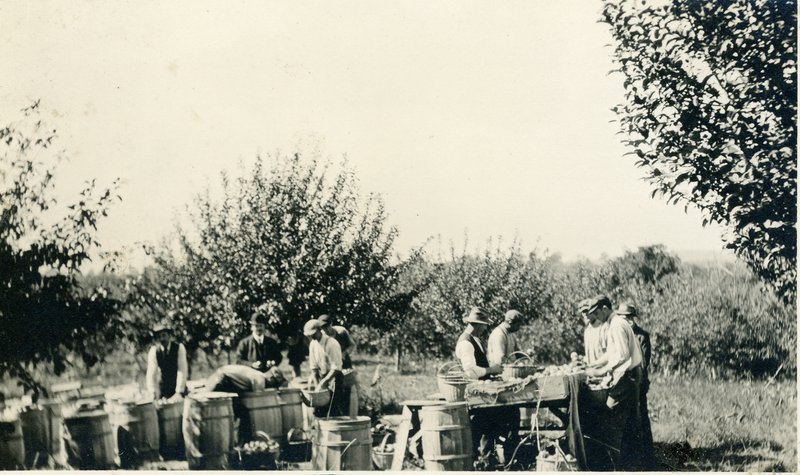
Packing McIntosh apples at the Teator Farm, 1915. Photograph by William S. Teator, from the personal collection of Sarah K. Hermans.
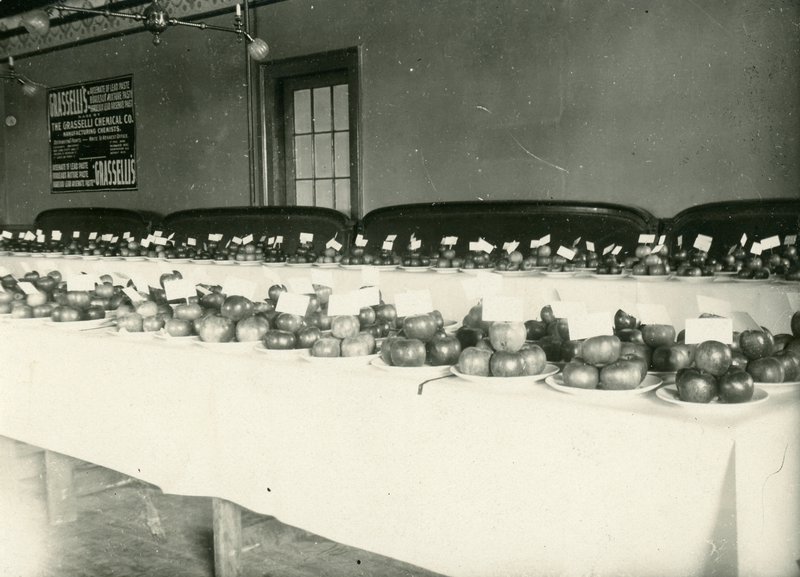
A display table of apple varieties, likely at a fair. Photograph by William S. Teator, from the personal collection of Sarah K. Hermans.
This project was developed because we believe that local history matters and that there are exciting possibilities for collaboration between the digital humanities and local historical archives. Currently, as we update our archives, this page serves as a short summary of the project.
To read and learn more, please visit the full project here, co-created with Digital History Lab, with support from the Experimental Humanities and the Andrew W. Mellon Foundation.